

Yu Xiuhua has become one of China's best-selling poets over the past three decades. [China Daily]
Mother-daughter relationship and an arranged marriage make for profound collections of works, Yang Yang reports.
In the summer of 1992, 16-year-old Yu Xiuhua graduated from junior middle school and was unexpectedly admitted to a local senior middle school. Her parents decided to take her to Beijing to try, for the last time, to treat the cerebral palsy she was born with due to breech presentation and hypoxia during a difficult delivery. The disease impairs her speech and mobility.
Hoping that Yu could go to university if her condition could be treated, they stood for eight hours on the train from Jingmen, Hubei province. After managing to grab seats, they sat for another nine hours before reaching the capital. However, four top hospitals in Beijing said that Yu's condition was untreatable.

Yu attends the Beijing event on Yu's new book. [China Daily]
During a night in Beijing, Yu woke to feeling her mother's hands, rough like sandpaper after years of housework and farm work, gently touching her legs. Her mother murmured: "If we can't cure this, will you blame me for bringing you into the world like this?"
Not daring to move or make a sound, Yu tensed her body, replying only in her heart: "How could I blame you? I've been like this since birth, and this is how the world has always appeared to me. I've never thought of blaming anyone."
Yu remembers this as one of the few intimate moments between them in a 30,000-character essay, Caojianshang De Muqin (Mother on the Tip of the Grass), about her mother Zhou Jinxiang, who died in 2016. This homage to her mother is included in Yu's latest essay collection of the same title.
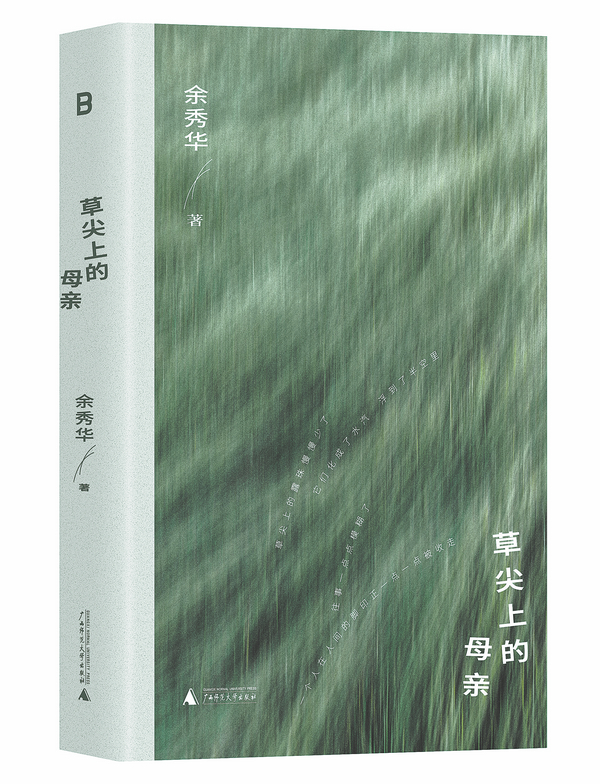
Covers of Yu's book: Mother on the Tip of the Grass. [China Daily]
Recently published by Guangxi Normal University Press, the new book includes five essays and a short story that Yu wrote in the past eight years, since her first essay collection, Wuduan Huanxi (Joy Without Cause), was published in 2018.
The essay Mother on the Tip of the Grass is a recollection narrated through the significant moments of Yu's life. Diary of Illness records the thoughts and feelings she experienced during a period of illness. The work Though a Person of Grass and Trees, Without the Heart of Grass and Trees offers glimpses of life throughout the seasons in Yu's home village of Hengdian in Hubei province. I Once Visited Xutu Village explores her personal emotions, her perception of her disabilities, the nature of love, and the meaning of life. The last piece, My Hengdian Village, My Michael (possibly paying salute to Amos Oz 1968 novel My Michael), is a personal narrative that blends elements of essays and fiction.

Singer Jin Minqi attends the Beijing event on Yu's new book. [China Daily]
Physical disabilities have never confined Yu's thought or diminished her vitality. On the contrary, as writer Yi Xiaohe says, "Look how exceptionally vibrant this woman is. As we navigate this often-bleak world, many things can leave us discouraged. But when I look at what Xiuhua shares on WeChat, I'm struck by how boldly she brings to light things that others might be too embarrassed or unwilling to express or acknowledge. It makes you realize she's authentic. She never downplays her love or hatred, and she doesn't even downplay her wounds."
Commenting on the book, Yi says a truly good work of nonfiction doesn't hide things; instead, it reveals the most genuine and contradictory aspects. It presents the complex side of a seemingly clear world, and Yu has achieved that.
A reader with the handle LizixiaojieMonica on Douban, a major Chinese review platform, echoes Yi, saying that Yu "shows us how someone who has emerged from the mud uses the blunt tool of prose to open herself up and illuminate the corners of our hearts that we dare not touch".
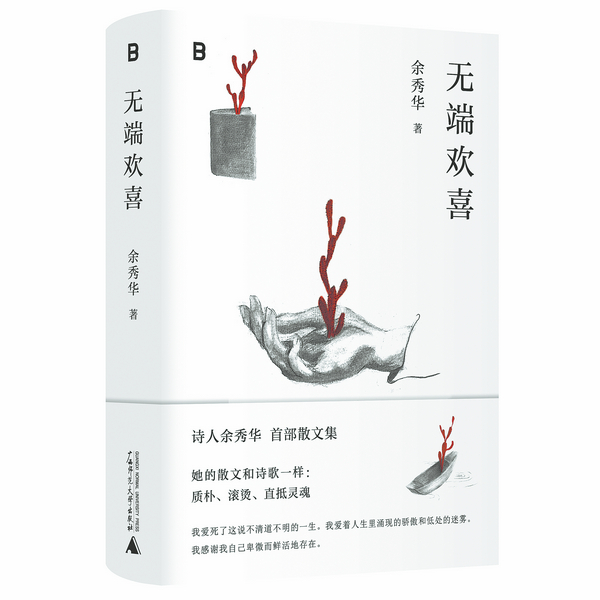
Covers of Yu's book: Joy Without Cause. [China Daily]
Facing an unusually cruel world for a disabled woman, humor becomes an important weapon for Yu. When many people online criticized her bold expression about erotic desire or menopause in her writings and on social media, Yu was never afraid to fight or even curse when responding to insults.
At a book event in Beijing in June, she showcased her humor by joking about menopause and erotic desires.
When asked about the book's title by a reader, Yu first joked that it was chosen without much thought, but she quickly added, "In the countryside, there's a saying: People are like blades of grass, with lives as insignificant as grass. When people say someone is like grass, it means they're more like a wild weed.
"That's why I think of the dewdrops on the tips of grass — they are so fleeting and disappear as soon as the sun shines on them. Every person's life is like grass: brief and ephemeral," she said, turning to the questioner: "Are you satisfied with my answer?" The audience burst into laughter.
The essay Mother on the Tip of the Grass is the most significant piece in the collection, where Yu represents the complicated feelings she has for her mother.
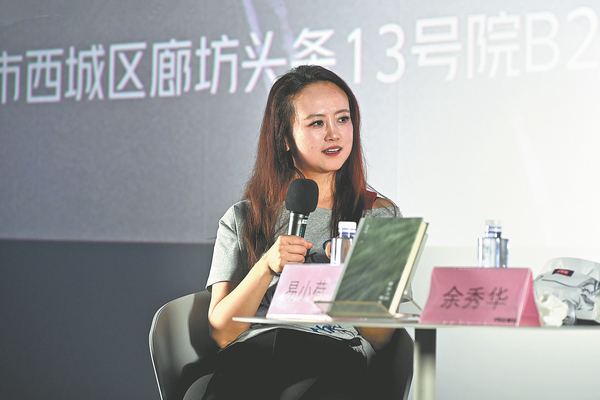
Writer Yi Xiaohe attends the Beijing event on Yu's new book. [China Daily]
"If there is a next life, Mother, please let us be strangers," the essay concludes.
"We didn't have an especially close mother-daughter relationship. … Just a faint emotional bond," she said, answering Yi's question about the relationship at the book event.
However, she undoubtedly loves her mother, although her mother criticized her and rarely offered any encouragement, "just like a mountain weighing on me".
She writes in a microblog on Sina Weibo: "After she died, the dewdrops on the tips of the grass dried and gathered, gathered and dried again. It took me five years to slowly gather her back, bit by bit." She spent five years completing the essay about her mother.
In China, writings about mothers often highlight their selfless love and greatness, but Yu says she does not think "great" is the right word for parents.
"Just because they gave birth to you doesn't make them inherently great; they deserve their own lives," she says.
"When I write about my mom, I want to show a different side of her.… I want to portray her as a real person, full of love, hatred, contradictions, and warmth. I want to depict her as a living, breathing woman, not just as my mother," she says.
She says that she is more interested in exploring how a woman lives, especially when she has a disabled daughter.

Covers of Yu's book: Flowers Bloom on the Back Hill. [China Daily]
"She can't possibly have that perfect, sweet love to give. She probably wanted a healthy child but ended up with a disabled one, which might have caused some resentment. There's no such thing as perfect or great maternal love, but the love she gave is genuine and undeniable. That's what I want to write about," she adds.
In 1976, Yu was born into a family of subsistence farmers in Hengdian village in Hubei. The physical difficulties due to cerebral palsy led to her dropping out of school after she had just started her third year at senior middle school. Soon after, her mother arranged for Yu to marry Yin Shiping, who was 13 years her senior, to ensure someone would take care of her.
The husband and wife did not get along. Yin worked in other cities, seldom calling Yu. They saw each other only during important Chinese festivals such as Spring Festival, and fought a lot, Yu told media in previous interviews.
Yu reportedly wrote her first poem, Yinhen (literally, Mark), in 1998. She favored the form for its brevity, given her struggles with writing. The poem has been lost, but Yu said in a previous interview that at the time, she kept trying to describe her own life experiences through poetry — she had been "crawling forward in the muddy water".
Yu started writing poems seriously in 2009, knocking out lines with her left index finger. In October 2014, her impactful poem Chuanguo Dabange Zhongguo Qu Shuini (Crossing Half of China to Sleep With You) became a sensation in China. In November that year, the Poetry Periodical ran nine of Yu's poems.
Commenting on her poems, Liu Nian, the journal's editor who discovered Yu, wrote in an article: "Her poetry stands out among female Chinese poets like a murderer in a group of well-bred young ladies — while others are neatly dressed, wear makeup, and are scented with perfume, their words clean and polished without a trace of sweat, hers are raw and gritty, with a smoky intensity. Between her words, you can see the unmistakable stains of blood."
In January and February of 2015, she published two poetry collections: Moonlight Rests on My Left Palm and The Staggering Shaky World. Within two months of its release, Moonlight Rests on My Left Palm went through four reprints. By March of that year, it had sold more than 100,000 copies, becoming the best-selling poetry collection in two decades in China. As soon as she received the royalties, she promptly initiated divorce proceedings, finalizing them in December of that year. She compensated Yin with 150,000 yuan ($22,155).
Over the next 10 years, Yu published two more poetry collections, an essay collection and an autobiographic novella collection, with sales surpassing 2 million copies. Her poems have been translated into various languages, including English, French, German and Spanish. In 2021, a French translation of her poem La Femme Sur Le Toit (The Woman on the Roof) was released. In 2021, the English translation of Moonlight Rests on My Left Palm: Poems and Essays was published by Astra Publishing House.
Since the second year of her marriage, Yu wanted to divorce her husband, but her mother was against it. The unfortunate arranged marriage had been one of the biggest miseries of her life and one of her deepest dissatisfactions with her mother.
"My mom was very hardworking, and I'm sure she loved me too; it's just that her way of showing it was different from what I wanted," she says.
"Honestly, I still haven't fully understood my mother, this woman. I also haven't figured out the true nature of my relationship with her, so I might need more time to think about this subject," she says.